

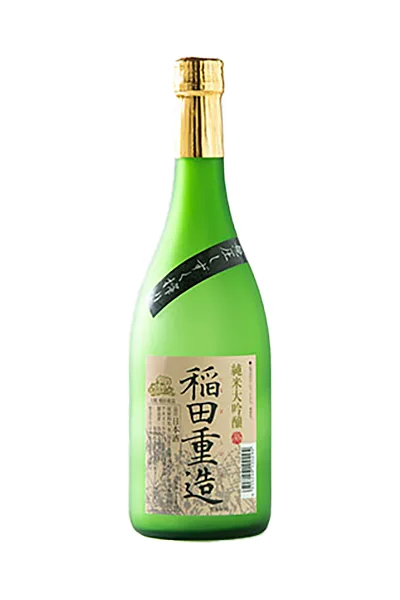
Inada Shigezo Junmai Daiginjo
稲田重造 純米大吟醸Junmai daiginjo, rice polished to 40%
Inada Shigezo — Okina Shuzo, Fukuoka
Crafted with care at every stage, from growing the rice to shipping, with each year's subtle shifts in temperature and rice quality met by the brewers' experience and skill.
Specifications
- Type
- Junmai Daiginjo
- Rice
- Not disclosed
- Rice polishing ratio
- 40%60% of each grain polished away
- Yeast
- Not disclosed
- Alcohol
- 15–16%
- Sake meter value
- +2slightly dry
How to read these
- Type
- The grade printed on the label. It depends on the ingredients (rice only, or with a little distilled alcohol) and on how far the rice is polished. More
- Rice
- The rice variety. Most premium sake uses varieties grown for brewing, such as Yamada Nishiki. More
- Rice polishing ratio
- How much of each grain is left after polishing. A lower number means more was milled away, which usually gives a lighter, more aromatic sake. More
- Yeast
- The yeast strain, which shapes the aroma. More
- Alcohol
- Alcohol by volume. Most sake is 15–16%; undiluted (genshu) sake is often 17–18%. More
- Sake meter value
- A sweet-to-dry scale. Plus is drier, minus is sweeter. Acidity changes how it tastes, so treat it as a rough guide. More
Flavor profile Rich & umami
Rich & umami — rice-driven umami and a fuller body. Known in Japan as jun-shu (醇酒).
The description states aroma is deliberately kept low with no fruity lift, and the palate is described as rich and abundant rather than dry. Polishing at 40%, SMV +2 and 15-16% alcohol support a restrained, full-bodied, moderately sweet profile.
Estimated by AI from the published specifications and the brewery's description; your impression may differ.
About
Generally, a small amount of brewer's alcohol is added near the end of production to draw out the ginjo aroma, but Inada Shigezo contains none. Also, to bring out the flavor of the ingredients, the aroma is intentionally kept somewhat subdued, so it lacks the fruity, high-toned aroma commonly associated with sake. As a result, the palate is not dry (karakuchi), as is typical of sake, but rich and full, showing the character of the ingredients. It has been well received by those who find dry sake too sharp, and by those who find other sake lacking but do not enjoy shochu.