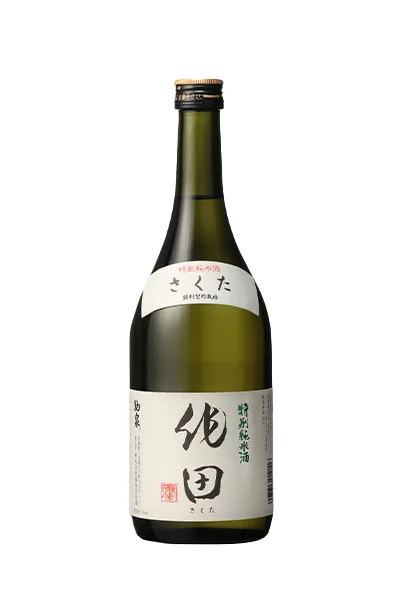
Sakuta Tokubetsu Junmai
作田 特別純米酒Tokubetsu junmai, rice polished to 60%
Sakuta — Morita Shobee, Aomori
Slips down smoothly on the palate, with a lightness that lets body and mind settle into their natural state. Then a gentle sweetness and the solid umami of rice.
Specifications
- Type
- Tokubetsu Junmai
- Rice
- Not disclosed
- Rice polishing ratio
- 60%40% of each grain polished away
- Yeast
- Not disclosed
- Sake meter value
- +3slightly dry
- Acidity
- 1.5
How to read these
- Type
- The grade printed on the label. It depends on the ingredients (rice only, or with a little distilled alcohol) and on how far the rice is polished. More
- Rice
- The rice variety. Most premium sake uses varieties grown for brewing, such as Yamada Nishiki. More
- Rice polishing ratio
- How much of each grain is left after polishing. A lower number means more was milled away, which usually gives a lighter, more aromatic sake. More
- Yeast
- The yeast strain, which shapes the aroma. More
- Sake meter value
- A sweet-to-dry scale. Plus is drier, minus is sweeter. Acidity changes how it tastes, so treat it as a rough guide. More
- Acidity
- Total acid. Higher tends to taste fuller and drier; lower tastes lighter and sweeter. More
Flavor profile Clean & dry
Clean & dry — restrained aroma, crisp and refreshing. Known in Japan as so-shu (爽酒).
The 60% polishing ratio, SMV +3 and acidity of 1.5 point to a restrained, dry-leaning junmai profile, and the description's smooth, light entry with gentle sweetness and rice umami places it in the light, restrained so quadrant with a modest richness.
Estimated by AI from the published specifications and the brewery's description; your impression may differ.
About
Sakuta Tokubetsu Junmai balances lightness and richness, pairing well with a wide range of dishes. It is made with 100% rice contracted for cultivation in Aomori Prefecture and brewed with crisp water from the Hakkoda mountain range. While it is a perennial favorite, the brand also releases seasonal versions, including Umakuchi (rich and flavorful), Karakuchi (dry), Soukou (refreshing), Ryoukou (cool and clean), Hiyaoroshi (autumn-released sake matured through winter), and Kimoto (traditional yeast-starter method), and it continues to evolve. The brush-written 作 on the label, which can also be read as 化, carries the sentiment that sake is the incarnation of the rice paddy (酒は田んぼの化身).
Other sake from this brand 5
- Sakuta Junmai Ginjo Muroka Genshu作田 純米吟醸 無濾過 原酒
- Sakuta Junmai Ginjo Shiboritate作田 純米吟醸酒 しぼりたて
- Sakuta Junmai Ginjo Natsu no Kasumi作田 純米吟醸酒 夏のかすみ
- Sakuta Junmai Ginjo作田 純米吟醸酒
- Sakuta Junmai Daiginjo Shizukudori作田 純米大吟醸 雫取り