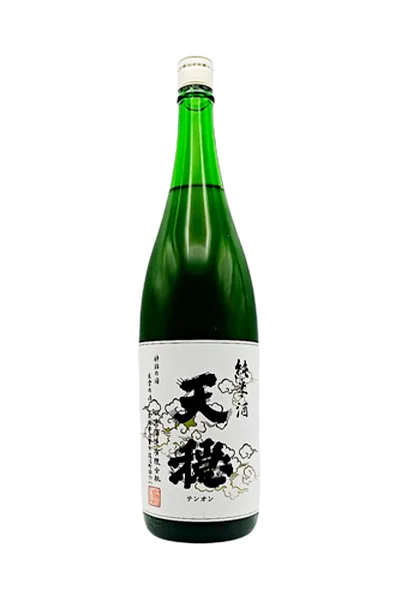
Tenon Junmai sake Gohyakumangoku
天穏 純米酒 五百万石Junmai, Gohyakumangoku rice polished to 60%
Tenon — Itakura Shuzo, Shimane
The classic junmai sake, true to the Ten-On style
Specifications
- Type
- Junmai Shu
- Rice
- Not disclosed
- Rice polishing ratio
- 60%40% of each grain polished away
- Yeast
- Not disclosed
- Alcohol
- 15.2%
- Sake meter value
- +7very dry
- Acidity
- 1.8
How to read these
- Type
- The grade printed on the label. It depends on the ingredients (rice only, or with a little distilled alcohol) and on how far the rice is polished. More
- Rice
- The rice variety. Most premium sake uses varieties grown for brewing, such as Yamada Nishiki. More
- Rice polishing ratio
- How much of each grain is left after polishing. A lower number means more was milled away, which usually gives a lighter, more aromatic sake. More
- Yeast
- The yeast strain, which shapes the aroma. More
- Alcohol
- Alcohol by volume. Most sake is 15–16%; undiluted (genshu) sake is often 17–18%. More
- Sake meter value
- A sweet-to-dry scale. Plus is drier, minus is sweeter. Acidity changes how it tastes, so treat it as a rough guide. More
- Acidity
- Total acid. Higher tends to taste fuller and drier; lower tastes lighter and sweeter. More
Flavor profile Rich & umami
Rich & umami — rice-driven umami and a fuller body. Known in Japan as jun-shu (醇酒).
A 60% polished junmai with SMV +7 and acidity 1.8 points to restrained aroma and dry-leaning sweetness. The blend with aged kimoto stock and the described spreading umami support a medium-full body, placing it in the jun type.
Estimated by AI from the published specifications and the brewery's description; your impression may differ.
About
We brew this sake aiming for a natural, moderate character that suits a wide range of people. Within the Ten-On lineup it is the most basic and has no major distinctive features, but I think it honestly expresses the direction of Ten-On. The basic composition of the white label is a blend of a 5BY new sake and a 4BY aged sake (kimoto). The 5BY new sake is made with Sanin Ginjo yeast and a three-day tsukihaze koji (koji made using the tsuki-haze method), and uses Sokujo No. 7 and Sokujo No. 6 yeast. The fresh, youthful vividness of the new sake is supported by the depth of the aged sake. In the early part of the 5BY season, temperatures and humidity were higher than usual, and the tsukihaze spread easily through the koji. Because I wanted to add a sense of Shimane character, I adjusted the koji-making to make use of this climate. I think it produced an umami that spreads out broadly. You may wonder when is the best time to drink this sake. As with human life, when a person remains pure both in youth and in old age, each stage has its own merits, and I hope you will regard enjoying the passing of time as the best way to drink it. This sake continues to improve as time passes, whether it is opened or bottle-aged. For bottle aging, room temperature suits it better than refrigeration. Because this white label is produced in large quantities, the final product is a blend of about 20 moromi (fermentation mash) batches. The rice specifications are the same throughout the year, and the product shipped year-round is always a blend of 5BY new sake and 4BY aged sake made with Sokujo No. 7 and Sokujo No. 6 yeast.
Other sake from this brand 8
- Tenon Haru no Tsuki天穏 春の月
- Tenon Tokubetsu Junmai Kaori天穏 特別純米 馨
- Tenon Kimoto Muroka Junmai sake Sakanishiki Gohyakumangoku天穏 生酛 無濾過 純米酒 佐香錦 五百万石
- Tenon Junmai Genshu Gohyakumangoku天穏 純米原酒 五百万石
- Tenon Junmai Ginjo Sakanishiki天穏 純米吟醸 佐香錦
- Tenon Kimoto Muroka Junmai sake Kairyo Omachi天穏 生酛 無濾過 純米酒 改良雄町
- Tenon Yamahai Muroka Junmai Yamada Nishiki天穏 山廃 無濾過 純米酒 山田錦
- Tenon Junmai Daiginjo天穏 純米大吟醸