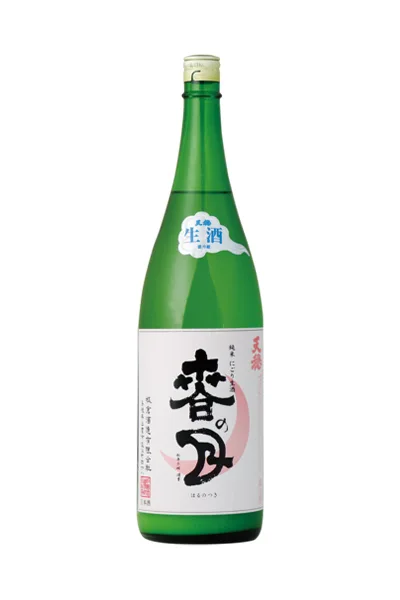
Tenon Haru no Tsuki
天穏 春の月Junmai, rice polished to 60%, unfiltered (muroka), unpasteurized (nama), undiluted (genshu), cloudy (nigori), sparkling
Tenon — Itakura Shuzo, Shimane
An annual favorite: a dry, unfiltered, undiluted nigori with a lively sparkle.
Specifications
- Type
- Junmai Shu
- Rice
- Not disclosed
- Rice polishing ratio
- 60%40% of each grain polished away
- Yeast
- Not disclosed
- Alcohol
- 18.3%
How to read these
- Type
- The grade printed on the label. It depends on the ingredients (rice only, or with a little distilled alcohol) and on how far the rice is polished. More
- Rice
- The rice variety. Most premium sake uses varieties grown for brewing, such as Yamada Nishiki. More
- Rice polishing ratio
- How much of each grain is left after polishing. A lower number means more was milled away, which usually gives a lighter, more aromatic sake. More
- Yeast
- The yeast strain, which shapes the aroma. More
- Alcohol
- Alcohol by volume. Most sake is 15–16%; undiluted (genshu) sake is often 17–18%. More
Flavor profile Rich & umami
Rich & umami — rice-driven umami and a fuller body. Known in Japan as jun-shu (醇酒).
The 18.3% genshu, 60% polished junmai with nigori gives a full, umami-rich body. The text describes a dry, sharp finish and a restrained, koji-led aroma with only a slight sweetness from the three-day koji, placing it in the jun quadrant.
Estimated by AI from the published specifications and the brewery's description; your impression may differ.
About
This spring's Haru no Tsuki is strong, with a clean finish (kire) and a dry, rich character. It recalls the sharpness and strength of Kaoru from my first and second years as toji, combined with the sweetness and amino acids produced by three-day koji (mikka koji). It has developed the hard edge of a Showa-era film actor of the rugged, manly type, with a sensual depth behind that hardness. This year's rice was said to be harder to dissolve than any in recent memory, following a record-level summer heat wave. At Ten-On, however, the rice dissolved readily, contrary to that advance word. Both the white-label sake and Kaoru came out at a sake meter value (SMV) of +7 to +10, and alcohol was 1 to 2% higher than in a typical year. I believe the hot, humid conditions that lasted until nearly December, together with the three-day koji, produced a resilient koji that could pierce the hard rice. The sake, with the mild sweetness and umami of this three-day koji and its tsukihaze-type amino acids, also carries the grassy, plant-like nuances and smoky aroma brought by the humidity. It is a solid, koji-driven sake that is truly Shimane in character. In professional sensory evaluation, this grassy, smoky aroma is an off-flavor known as 4VG. For a local sake, however, if it is not too strong, it can be understood as the fragrance of home, carrying a nostalgic atmosphere that expresses the climate and the land. It is a spatial aroma released by moss and lichen, which are sensitive to moisture in the air. Last year it smelled like sakura mochi; this season it is closer to rice straw. The aroma fades as winter brings lower humidity. Because the base sake Kaoru came out robust, the nigori was taken from a beautiful, somewhat soft moromi of Sakanishiki Junmai Dai (純大). The proportion of nigori is also on the high side. The sake has a solid impression but is quite drinkable, and the more you drink, the more distinctly Ten-On it becomes. It is a limited release with small quantities. Thank you for your support.
Other sake from this brand 8
- Tenon Junmai sake Gohyakumangoku天穏 純米酒 五百万石
- Tenon Tokubetsu Junmai Kaori天穏 特別純米 馨
- Tenon Kimoto Muroka Junmai sake Sakanishiki Gohyakumangoku天穏 生酛 無濾過 純米酒 佐香錦 五百万石
- Tenon Junmai Genshu Gohyakumangoku天穏 純米原酒 五百万石
- Tenon Junmai Ginjo Sakanishiki天穏 純米吟醸 佐香錦
- Tenon Kimoto Muroka Junmai sake Kairyo Omachi天穏 生酛 無濾過 純米酒 改良雄町
- Tenon Yamahai Muroka Junmai Yamada Nishiki天穏 山廃 無濾過 純米酒 山田錦
- Tenon Junmai Daiginjo天穏 純米大吟醸